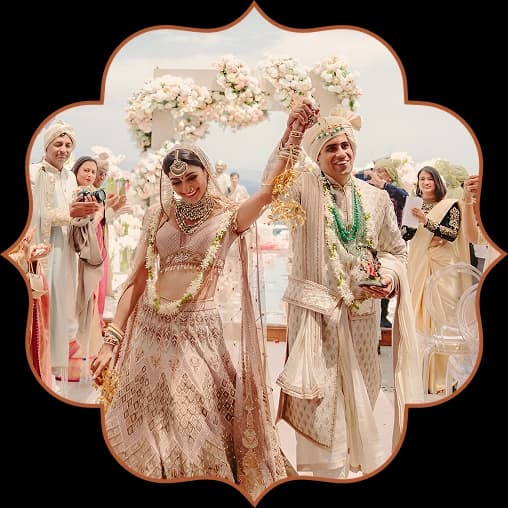
When the groom steps out for the baraat, he has been made up so far by the time he puts his feet out of the door he has a sherwani on his body, lots of jewellery hanging off his neck and shoulders, a safa or pagdi (Indian turban) wound up on his head. A spark or two is places on the front and the whole look seems complete. That sparkle is a kalgi and this is what a kalgi for a groom represents in Indian wedding traditions.
A kalgi for groom is an ornament that is fixed on the front of the turban covering, always making a little bit of rise over the tissue. As a groom's turban décor, it is the one thing that is always placed at face level in almost all wedding shots.
The front end of the groom's safa or pagdi, where the cloth is folded up into a neat peak.
The majority of the pieces resemble a brooch which has been mounted with a jewel, but there is also a piece which incorporates a feather or plume.
Kalgi styles include heavy, stone-heavy pieces and lean, subdued styles; some families forgo the jingle altogether.
The wedding kalgi's ties to royal and ceremonial dress in other regions of India is most evident in this wedding day beauty, but there is also a hint of it in the kalgi's actual history. Beyond that documented history, the kalgi for groom meaning is personal to each family.
Royal Connections: A groomsman in one looks to be slightly better dressed than a man of some social standing, which is the surface and most widely known face of it.
Contemporary Kalgi Designs: The majority of the grooms go for mild kalgi patterns or search for more kalgi design inspirations that complement a more contemporary attire.
Good to talk over with the Family: Spending 10 minutes with your elders telling them what the kalgi tradition means in your family usually ends up in stories not seen online, and a kalgi ceremony for groom that looks good in pictures may be over in seconds.
Our overview of Indian wedding rituals has more context.
Kalgi ceremony usually takes place before the wedding begins, while the bridegroom is getting ready. Putting on a kalgi for groom is nothing more than a part of post-wedding proceedings and many families do not even have a specific kalgi ceremony for groom. Here is a breakdown:
Getting Ready: The groom gets dressed with help from a family member. The safa or pagdi is folded or dipped until it fits properly.
Kalgi Placement: The ornament is placed and fastened at the spot where the family generally puts it usually at the front.
Final Check: The groom wraps up his look and is good to go for whatever the day might entail. Again, the Indian wedding ceremony process could be a little different, depending on the community.
Each of the three words dance around relatives and wedding vendors, and here's what they're used for below.
Searching for Kalangi for groom or Kilangi for groom will take you to the same type of turban piece.
Not an assurance. There is nothing to say that the designs or origins are the same and make alterations by area, so think about the kilangi patterns in a list just as an identical item and not inevitably an equivalent one.
|
Term |
How it is used |
|---|---|
|
Kalgi |
The key word in this article and the most commonly used |
|
Kalangi |
One spelling variant, as in kalangi for groom and kalangi ceremony |
|
Kilangi |
Another form of spelling |
It's also a styling question, not a shopping one, and selecting a kalgi for the groom becomes easier once you've finalized the outfit.
Colour: The ornament should never argue with the safa or pagdi. The more flamboyant the turban, the more subtle the ornament and vice versa. How to choose your wedding colours (below) is one of our most important explainer posts and is all about settling on the palette first.
Scale and mood: Place the size in comparison to the sherwani, the necklace, and any brooch, then determine whether the overall style is traditional, simple, or more regal. For grooms in more minimalist attire, the kalgi should be small and simple.
Comfort: Pinned close, and feeling light even after hours of dancing.
Yes browsing kalgi design ideas makes you more excited or excited about it. To help to get your wedding style first if you still do not have a general appearance.
The right kalgi can elevate the groom's wedding attire by adding a touch of elegance, tradition and royal charm. When choosing a kalgi for the groom, consider the outfit, turban style and overall aesthetic to ensure every element complements the final look.
|
Groom's Styling Choice |
What to Consider |
|---|---|
|
Traditional Sherwani |
Match the kalgi embellishment with the overall colour scheme of the sherwani. |
|
Contrasting Safa |
Choose a kalgi that complements the turban without being overshadowed by its colours or embellishments. |
|
Minimalist Outfit |
Keep the kalgi subtle to maintain a balanced and understated look. |
|
Royal-Motif Look |
Coordinate the kalgi with the turban, jewellery and embroidery to create a cohesive royal appearance. |
Kalgi can have a lot of sentimental value for some families, but the rituals and sentiment may vary from place to place and family to family. Here are a few guidelines before incorporating it into your wedding rituals.
For a few families, the Groom kalgi is an integral part of wedding traditions and not to have one would be considered strange, to others, it is strictly an optional thing. It can be called by many names – kalgi, kalangi or kilangi.
Get to know the religious and or cultural implications of the ritual with a senior and a priest of that particular tradition so that you may be able to incorporate it into your celebration.
Unless families who follow kalgi for groom ceremony incorporate it into other customary ceremonies or include it in their wedding day prep.
Preserve your family traditions and create a memorable wedding celebration with Destination Wedding Bharat. We work closely with the couples, so you focus on celebrating your love and we handle the details by ensuring you are able to celebrate your wedding with preserved family traditions.
A kalgi for groom is a small finishing piece, and how it is used and what it means rests on family custom. Some weddings include one and some do not. But for that you need to hire the best destination wedding planners in India. Destination Wedding Bharat helps couples think through the details of their celebration, from traditional wedding customs to the overall experience, and our guide to destination wedding planning is a good next step.
No. In many families it is just part of getting the groom ready and some others give it a brief time of its own.
It depends on the family and the region. It may be a relative or assisting the groom to get ready, and there's not a set individual for the service across traditions.
Of course not. The boutonniere is a customary part of the wedding attire in certain cultures but its wearing is subject to the groom's discretion, the family traditions and his outfit.
Typically near the front of the turban, where it is visible clearly as part of the look. The precise position of the kalgi depends on the style of turban and how the kalgi is secured in place, so it is worth trying it on during the outfit fitting.
The kalgi is the ornament attached directly to the turban. The sehra is a different piece, typically a string of flowers or decorative cords tied across the face or forehead, and their use varies by tradition.